You Should Know
No building is perfect. You should know...
THE ROOF PAVERS CRACK
These pavers were a brand new product when I bought them and they still had some production kinks to work out. There was a quality issue with the adhesive that holds the granite veneer to the fiberglass substrate, and once water gets in between these two layers it eventually freezes and cracks the granite.
I've ordered a palette of new pavers and will replace all the ones that are currently broken, but they will likely continue to crack in the coming years and it is a hassle to replace them.
UPDATE 9/4/2018: New pavers arrived and have been installed. There are extras in the basement to cover any that may crack in the future.
THERE IS A CRACK IN THE SOUTH EAST WALL
There was a weed tree in the yard that got cut down, and the theory is that when the roots rooted themselves out they caused the South East corner to settle a bit. This crack should be easy to stitch up with the only complication being that it is in a landmark district as described below.
THE ELEVATOR BUMPS
On the way up you will hear a disconcerting bump as the elevator travels between the 2nd and 3rd floors.
This noise has been there since the day the elevator was installed. I've had the brightest minds in the elevator business try to figure out where it is coming from over the years. The leading theory was that there was an imperceptible grove where the two sections of the rod are joined together, and this grove was releasing a microscopic slug of high pressure oil as it passed though the gland.
Based on this diagnosis Pro Elevator spent hours and hours re-honing that joint to a perfect mirror shine. It had no effect on the bump.
Rick at Pro Elevator has given his word that there is no safety or reliability issue here, and I trust him completely. VDA concurred. The past 10 years of operation seem to confirm this, but the noise remains disconcerting to those who do not expect it.
I strongly advise you to bring in your own elevator expert to take a hard look. The best case scenario would be for them to solve the mystery!
[Video was embedded here showing the elevator bump]
SHRINKING POST BLOCKS
It was very hard to find lumber that matched the existing massive 12"x12"'s , so when we finally found some everyone rejoiced. Unfortunately in our euphoria, no one tested this new wood before it was installed. Of course it turned out to have high moisture content, and so it shrank. This shrinking manifested slowly so by the time I realized what had happened, I was already living in the space and reluctant to fix it since the impact was primarily aesthetic.
Since wood shrinks primarily across the grain, this issue mainly impacts the horizontal blocks that are the tops of the posts. Because of this shrinking, the floor above each block where new lumber was used has dropped out of level. This drop is non-uniform since the distribution of old blocks and new blocks was essentially random. It is also cumulative in places where new blocks were stacked on top of each other in the same line.
The effect is most apparent near the 3rd and 4th floor landings since this line happened to get new blocks in multiple places. The floor is visibly lower here and it has put the adjacent door frames out of square so the doors rub on the floor.
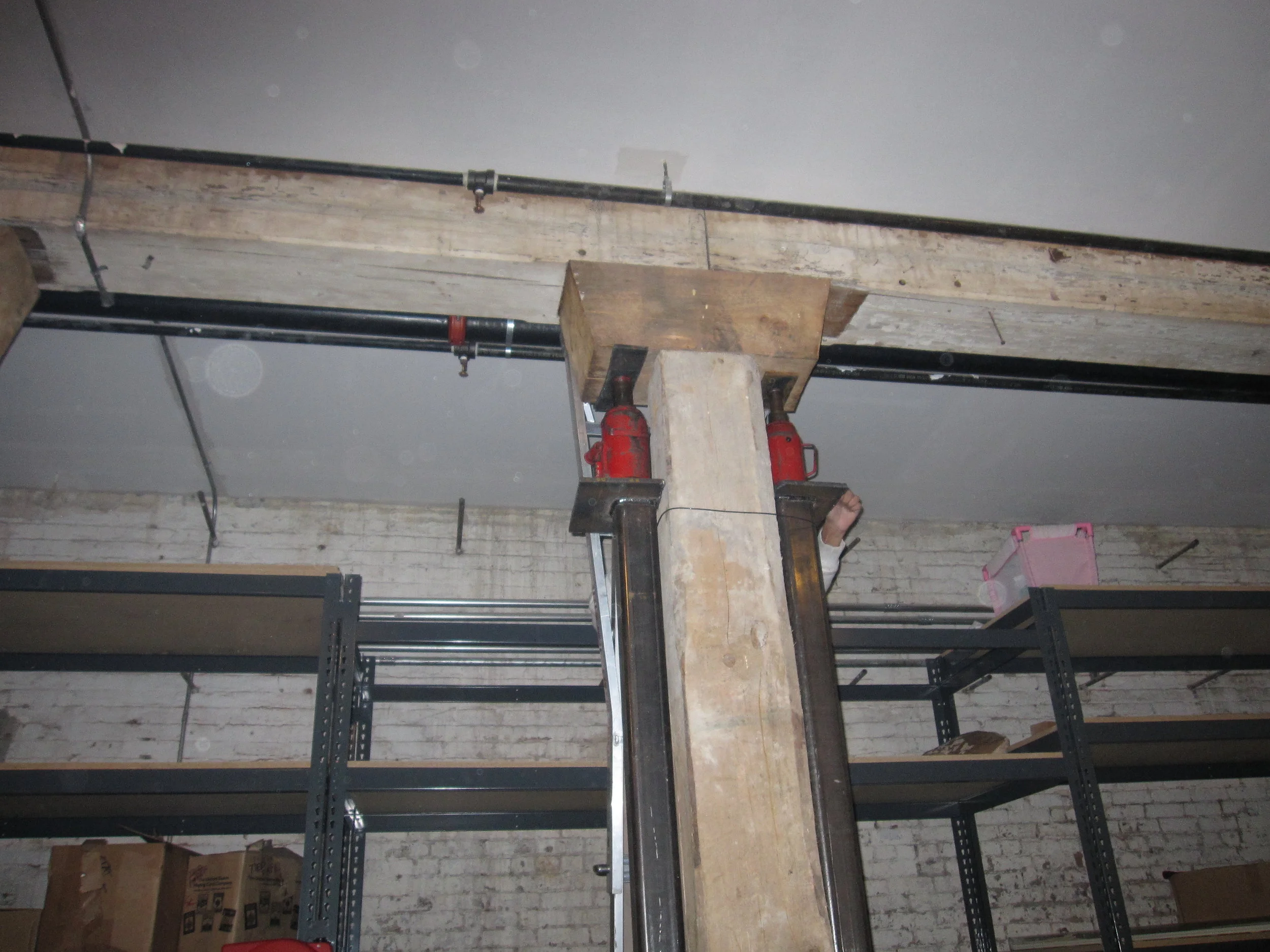
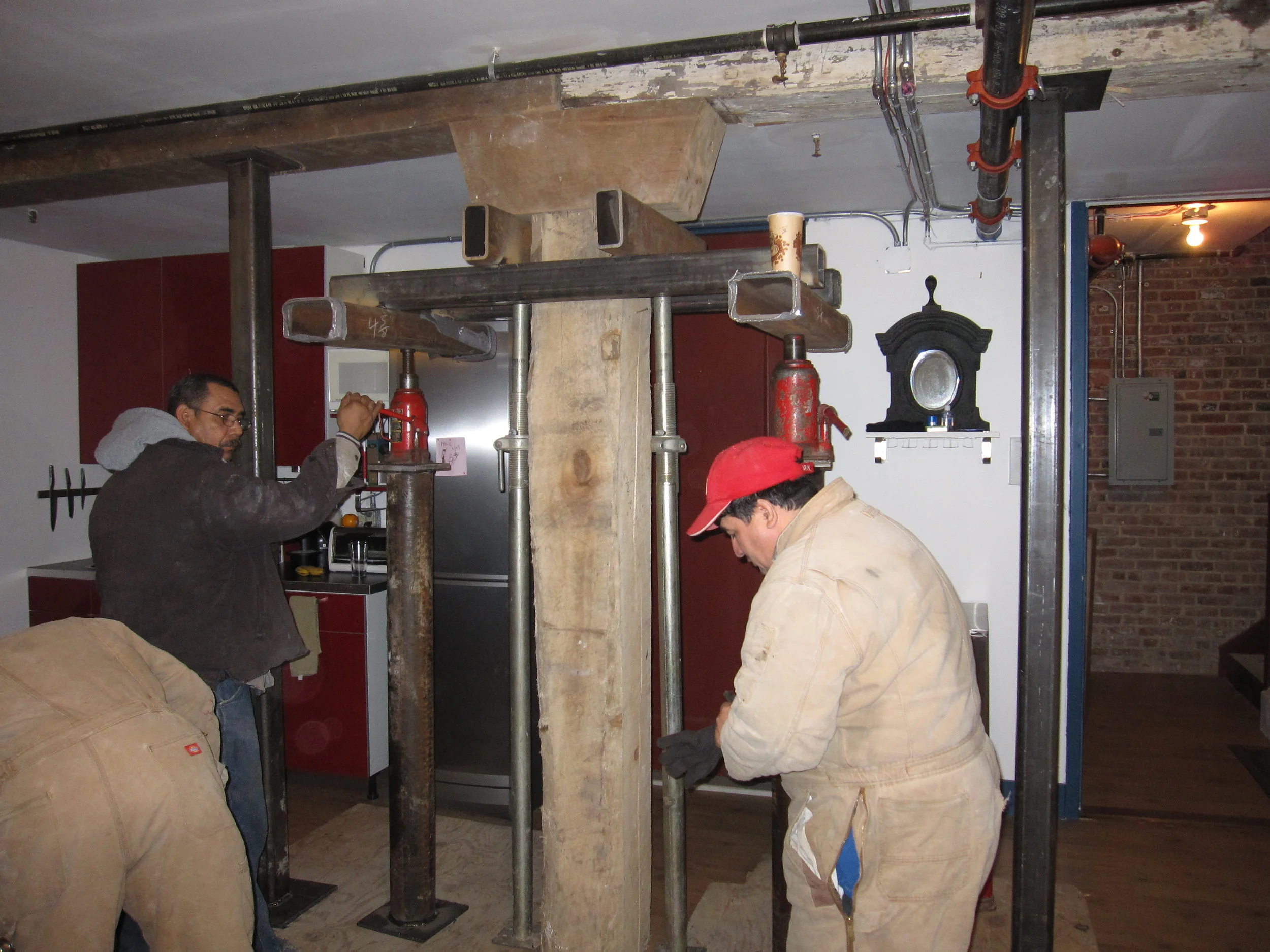
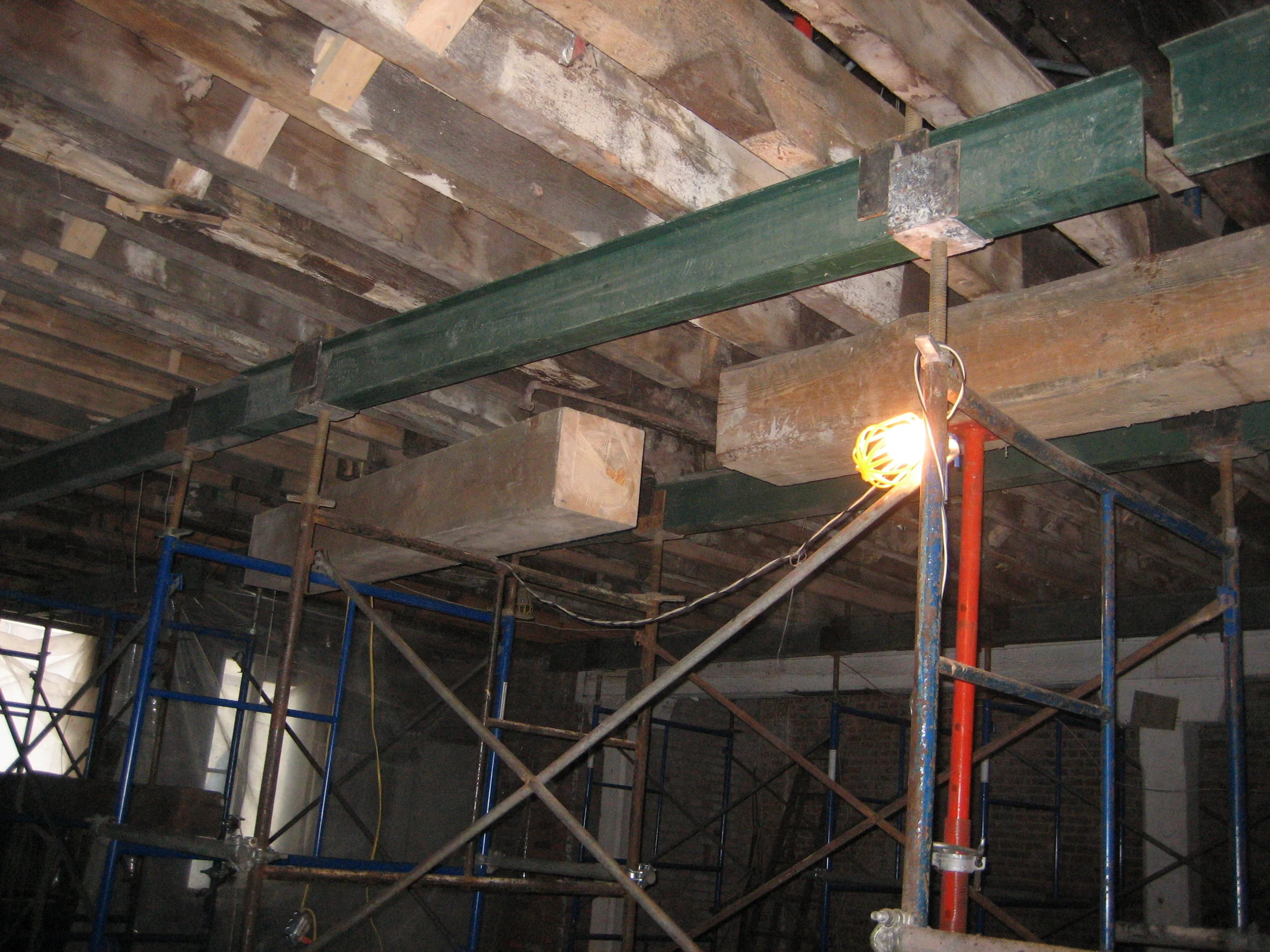
The fix for this problem is straightforward, but nerve racking. For each effected block, you put cribbing under the supported beams back into level. Then you either shim below the existing block or replace it with a properly dried!!!) one. I've done this procedure in the couple of places where the impact was more than aesthetic.
The first place where it had to be fixed was near the old elevator shaft on the 2nd floor. Because the block in question was embedded in the elevator shaft wall, it is does not have a joint above the block to flex. The shrinkage of the new block left the elevator shaft beam unsupported from below. Here is what it looked to like fix that...
The second place was underneath the 2nd floor kitchen since the slant was causing problems with the properly. Here is the fix for that...
I am not going to sugar coat this one. It is terrifying procedure to watch. The building groans and creaks like a ship in a storm. I am happy to live with the unlevel floors and scraping doors all these years!
THE FLOOD
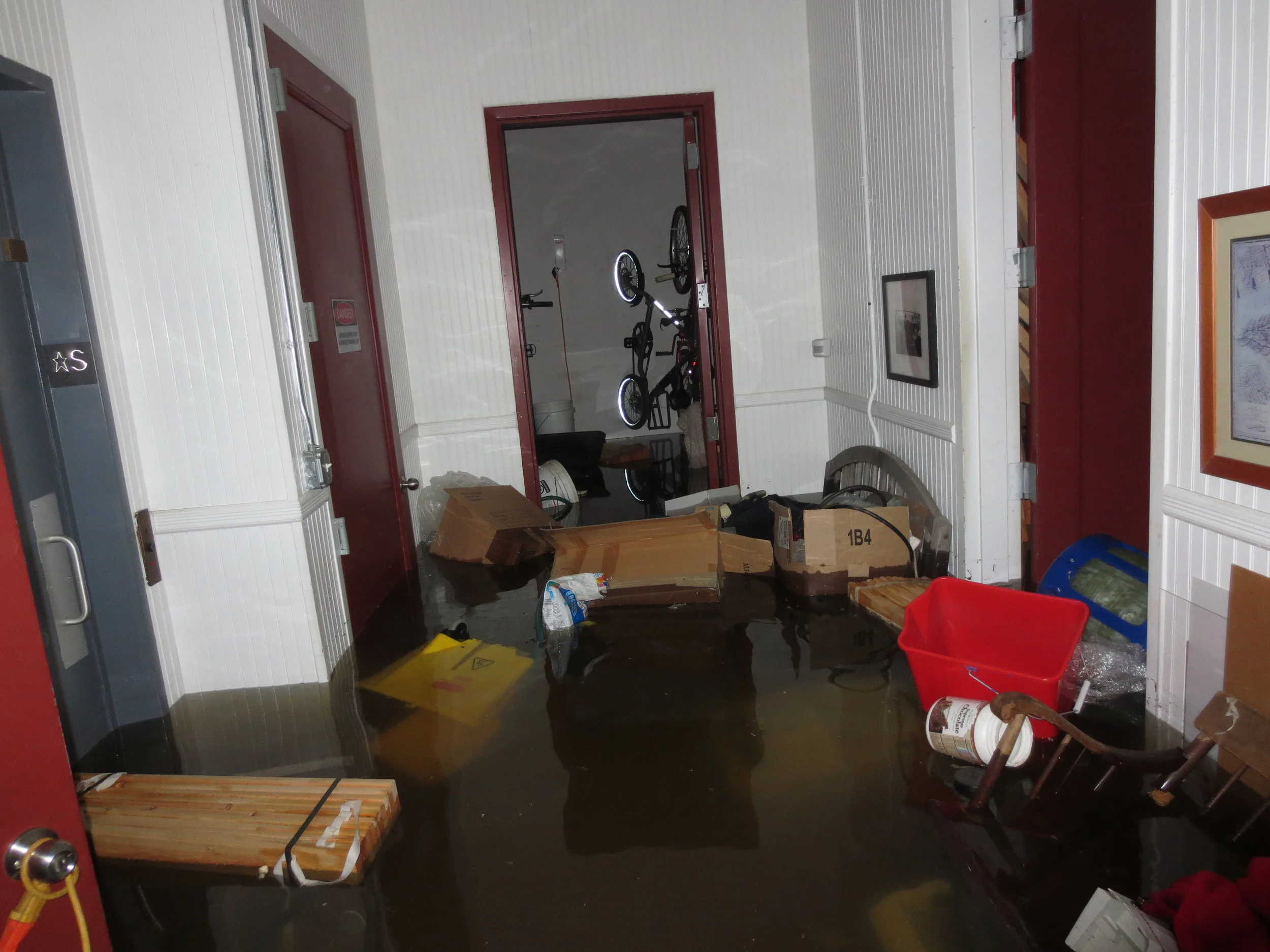
This is Water Street, and when Sandy came so did the water. It was nearly waist high in the lobby.
Luckily the water receded as quickly as it came, and we were able to pass the DOB inspection immediately. Since we had solar panels on the roof, we even had the only working phone chargers and hot showers in the neighborhood for several days after.
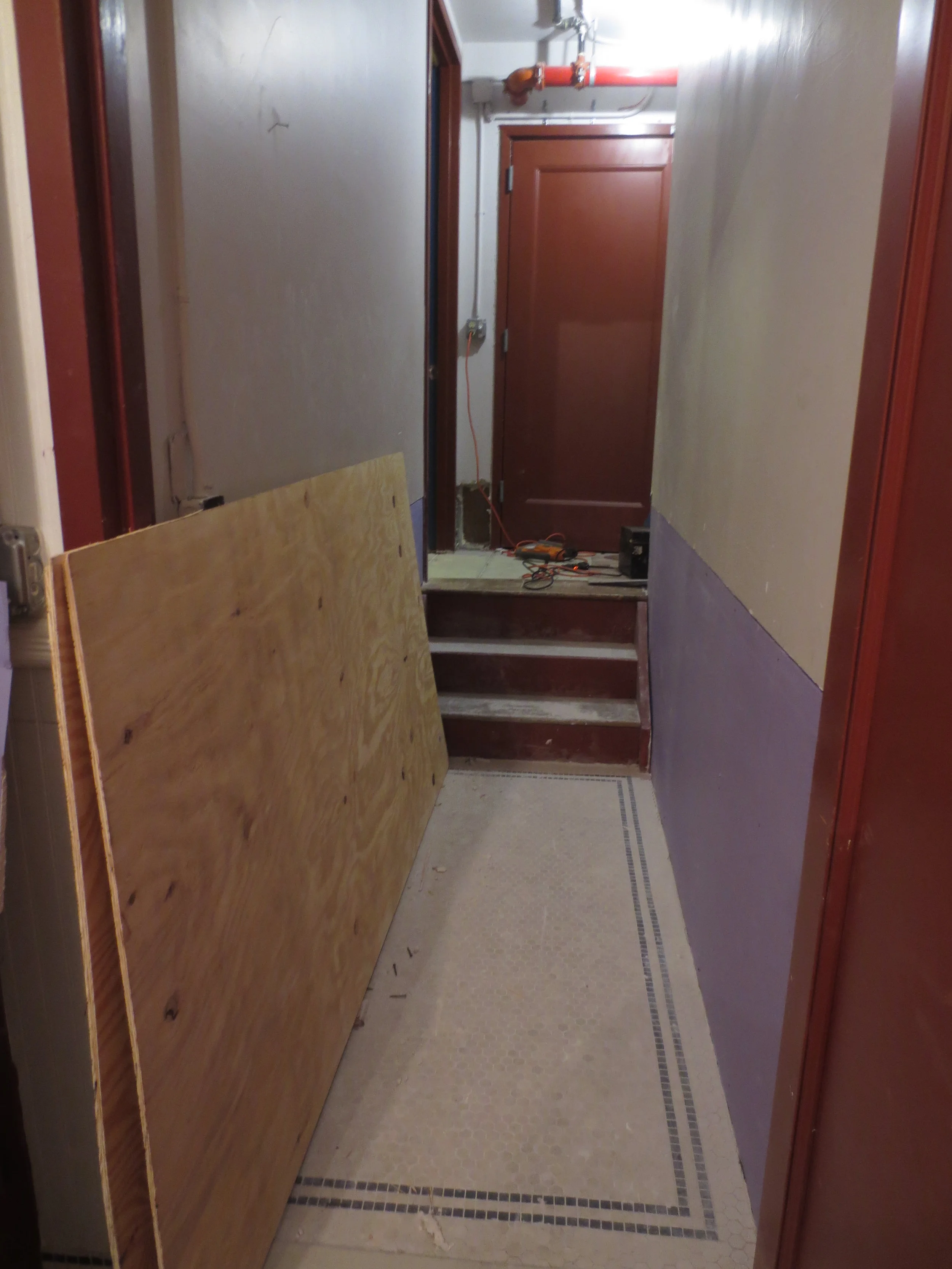
It seems inevitable that there will be another flood at some point in the future, so I replaced all the mechanical systems in the basement and painted them with purple waterproof stuff, added quick connects to the boiler and hot water heat in the basement, raised the electrical panels above the flood line and installed removable outdoor lighting in the basement.
If (when) the next flood comes, it should be a simple matter of moving everything stored in the basement up to the 2nd floor landing along with the boiler and hot water heater. After the flood you will want to hose down the basement and then you should be able to get back to normal pretty quickly. I highly recommend keeping a small portable generator there is line that attaches to a quick connect in the 4th floor laundry room to keep it running independently rather than hardwire connections to make it easy to switch them over to the backup power.
LANDMARKS IS SLOW AND UNPREDICTABLE
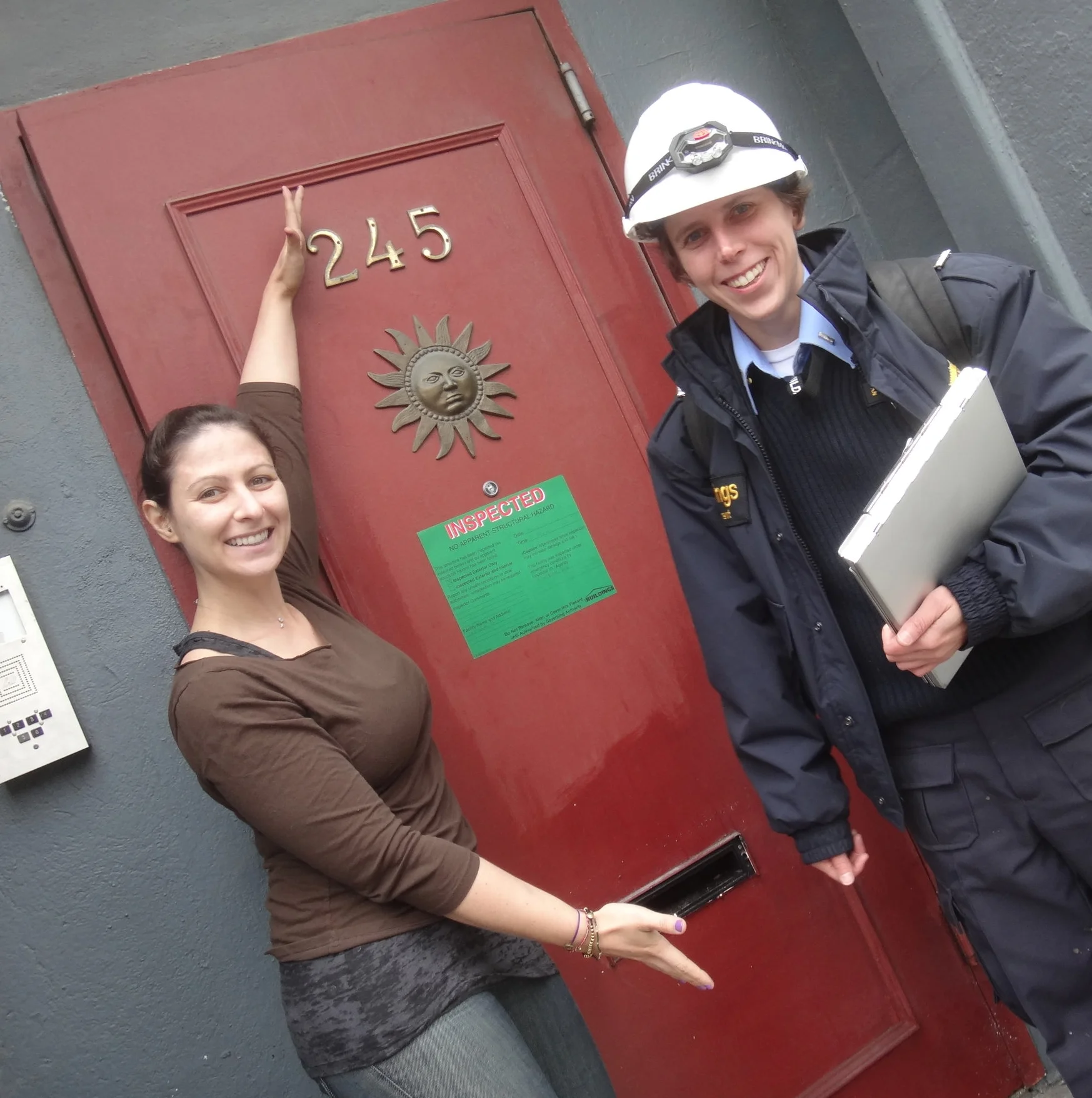
With all the of the great upsides that come with being in the Seaport Historic District, there is one significant downside. You need to get Landmarks Commission approval anytime you want to change the appearance of the outside of the building. As long as what you are doing is "appropriate" then you will eventually get approval, but it can take a while.
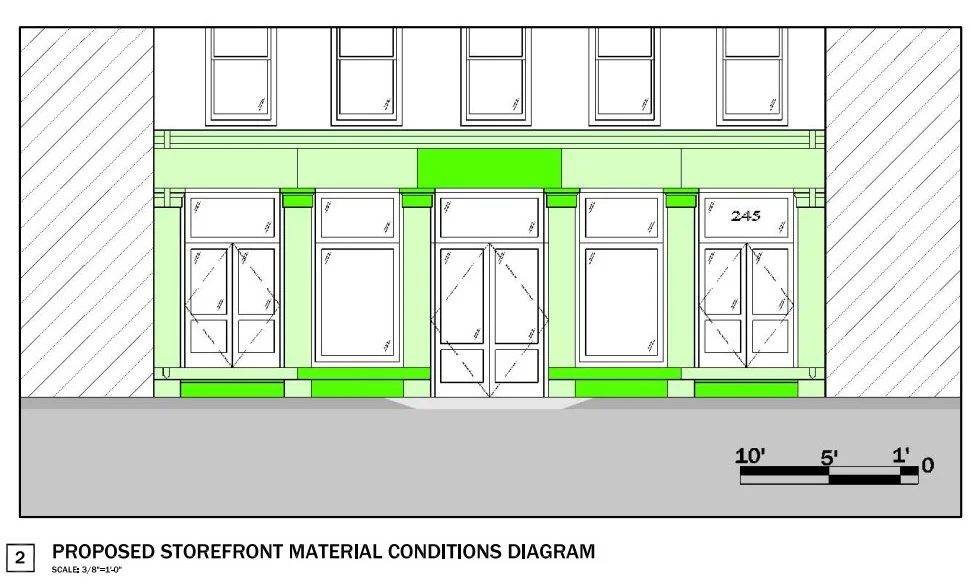
Architects and expediters will tell you they do this all day and they can get anything approved in a few months. This is not always true. It took over a year to get a new storefront approved despite hiring an architect with experience in LPC work, and hiring an architectural historian to work on the design.
Assume landmarks will take at least twice as long to get something approved as anyone tells you, keep in mind that it can take even longer.
THE ELEPHANT ACROSS THE STREET
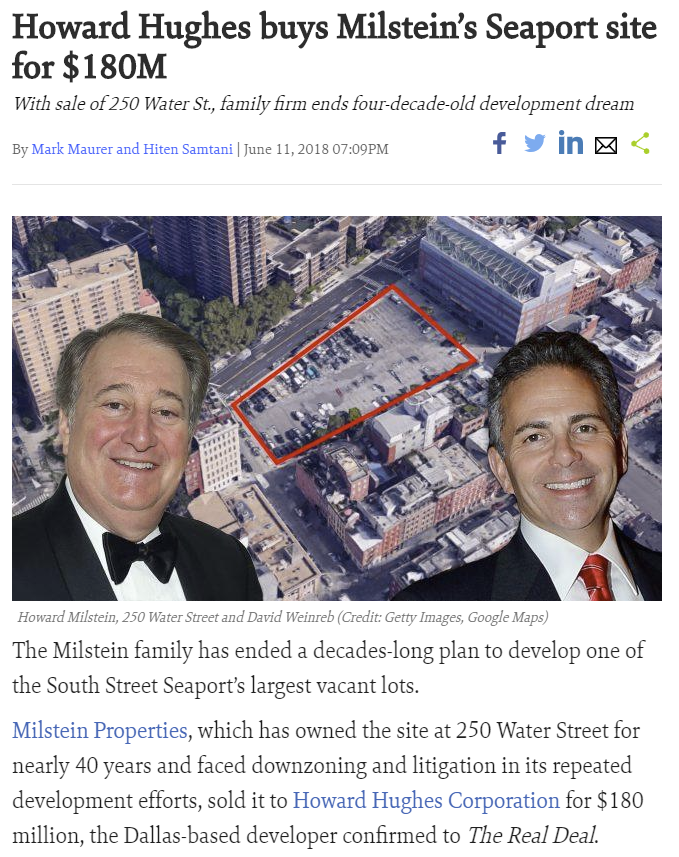
The parking lot across the street was recently sold to the giant Howard Hughes Corporation. They are not building anything there, but considering the $180,000,000 it cost them, it seems unlikely they will leave it as an open parking lot.
Long term this likely a good thing. This indicates that they are bullish enough on the Seaport to develop their investments here. Any structure on that lot would also likely disrupt the sight lines that currently limit the buildable hight at 245 Water Street.
Short term this is likely a bad thing. I've lived next to a construction site in NYC before and it be big, so we are talking pile driving and cement trucks and hammer banging- potentially for years. In the current layout all the bedrooms at 245 Water Street face the back side of the building so you probably won't be too bothered by the noise, but it will still suck.